


For many patients, the words “root canal” sound frightening. Yet with modern anaesthesia and equipment, endodontic treatment is now a routine and virtually painless procedure – and often the only way to save your own tooth instead of having it extracted.
Below we answer the questions patients ask most often before this treatment.
What is root canal treatment?
Inside every tooth there is the pulp – soft tissue containing nerves and blood vessels that runs through the canals all the way to the tip of the root. When decay, a crack or an injury reaches the pulp, it becomes inflamed or infected.
Root canal (endodontic) treatment involves removing the diseased pulp, cleaning and disinfecting the canals and then sealing them hermetically. This stops the infection, and the tooth stays in your mouth and keeps functioning.
When is root canal treatment needed?
The most common signs that the pulp is affected are:
- severe or throbbing pain, especially at night
- sensitivity to hot and cold that lingers after the stimulus is gone
- pain when chewing or touching the tooth
- swollen gums or a “gum boil” near the tooth
- a tooth that has darkened
It is important to know that an inflamed or infected tooth sometimes does not hurt at all. In that case the problem is discovered only on an X-ray, which is why regular check-ups matter so much.
Does root canal treatment hurt?
This is the most common question – and the answer is reassuring. The treatment is done under local anaesthesia, so it feels much like getting an ordinary filling. The pain patients remember is usually the pain of the inflamed tooth before treatment, not of the treatment itself.
For a few days afterwards the tooth may be slightly tender when biting. This is a normal tissue reaction and usually passes on its own or with a common painkiller.
What does the procedure look like?
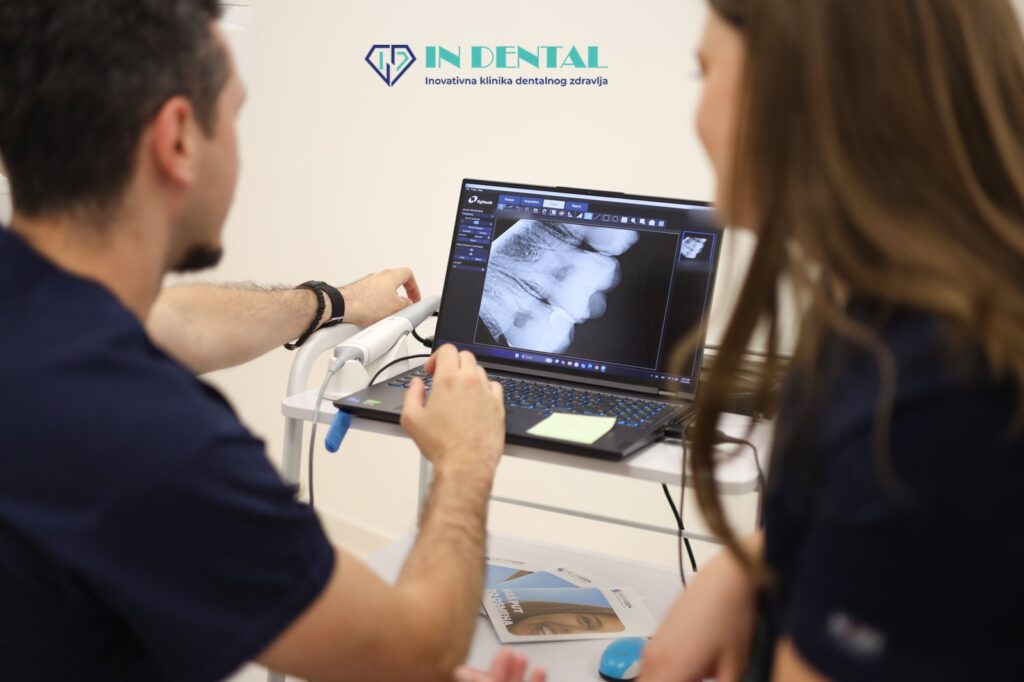
- Examination and X-ray – the X-ray shows the number and shape of the canals and how far the infection has spread.
- Anaesthesia – the tooth and surrounding tissue are completely numbed.
- Removing the pulp – the dentist opens the tooth and removes the diseased tissue from the canals.
- Cleaning and disinfection – the canals are shaped and rinsed with disinfecting solutions. In our clinic we also use a laser for additional canal sterility, which lowers the risk of re-infection.
- Filling the canals – the cleaned canals are hermetically sealed with a special material.
- Restoring the tooth – the tooth is closed with a filling or, if needed, a crown is planned.
How long does root canal treatment take?
One visit usually takes between 45 minutes and an hour and a half. Simpler cases can be completed in a single visit, while teeth with several canals or a more severe infection usually need two to three visits. Between visits, medication is placed in the canals and the tooth is closed with a temporary filling.
How much does root canal treatment cost in Novi Sad?
At InDental, endodontic treatment starts from 7,500 RSD (approx. €64). The final price depends on the number of canals (front teeth usually have one, molars three or more), the condition of the tooth and how it will be restored after treatment.
You will get the exact price for your case after an examination and X-ray, and you can find current prices for all services in our pricelist.
What happens after root canal treatment?
A tooth with treated canals no longer has a nerve, so it does not feel hot or cold, but over time it becomes more brittle. That is why a crown is often recommended to protect it from fracturing – especially for back teeth, which take a lot of chewing pressure.
With good oral hygiene and regular check-ups, a properly treated tooth can last for years, even decades.
Why is it better to save a tooth than to extract it?
Extraction may seem like the quicker solution, but a lost tooth later has to be replaced with an implant or a bridge, which is more expensive and more demanding. A gap also causes neighbouring teeth to shift and leads to bone loss. Whenever possible, your own tooth is the best solution.
Don’t put off your visit
The sooner you act, the simpler, shorter and more affordable the treatment. If you feel pain or sensitivity or notice swelling, book an examination at InDental in Novi Sad – or send us your X-ray through our online consultation.
Recent Posts
-
 Root Canal Treatment – Does It Hurt, How Long Does It Take and How Much Does It Cost?
-
 How to Achieve a Natural Smile? What to Know Before Cosmetic Dental Treatment
-
 Does Wisdom Tooth Removal Hurt? What to Expect During Recovery
-
 Teeth Aligners – The Invisible Way to a Perfect Smile
-
 Bleeding Gums – Causes and When It’s a Warning Sign?